CCCPunk
It mixes academic research + professional practice to create both finished products and experimental systems — including installations, prototypes, self-initiated material objects, design technology and speculative projects.

CCCPunk
Speculative Soviet Retrofuturism: Everyday Life in an Alternate Technological Future
Speculative Research + Concepts
“What kind of robotic machine would there be if the Soviet Union still existed? How would Constructivism or the Cosmist aesthetic have evolved? How would collectivism and undivided property have influenced the form and typology of robots?”
CCCPunk is a speculative and dystopian exploration of unrealized possibilities. Based on a text mining and image analysis analysis of hundreds of written documents and images from the Soviet era, it used the extracted data as input for generative AI, creating images, videos, and environments poised between the possible and the improbable.
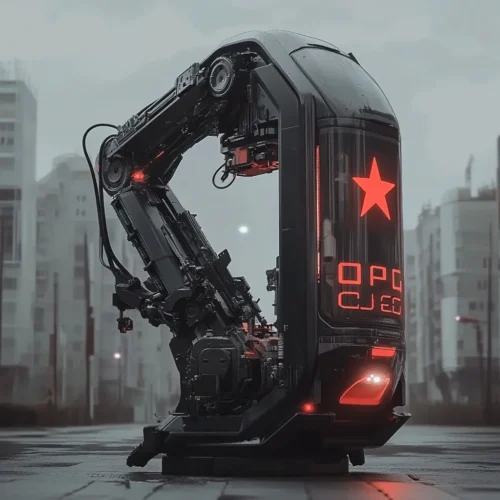
-CCCPunk_Concept Collective Working Machine-
Videos and images are part of a broader speculative research framework that investigates Soviet cultural continuity through a post-historical and techno-anthropological lens.
The project starts from a counterfactual premise: What if the USSR had not collapsed? What aesthetic, social, and technological trajectories might have emerged from a continuous socialist paradigm — one evolving into a hybrid of cosmism, industrial futurism, and proletarian vernacular aesthetics?

-CCCPunk_Interior of a Soviet Dacha, 1969-
At its core, the research is based on an extensive archival and dataset-building process. Thousands of historical photographs, propaganda posters, domestic interiors, industrial machines, and youth subcultures have been collected, digitized, and organized into thematic datasets.
Through text mining, historical documents, manuals, and cultural essays are algorithmically analyzed to extract recurring linguistic patterns — ideologemes, rhetorical constructs, and terminologies of production, progress, and collectivism.


-CCCPunk_Group of soviet young, 1974-1988
In parallel, image analysis techniques — such as feature extraction, clustering, and color morphology detection — are applied to visual archives to identify underlying aesthetic grammars: chromatic tendencies (oxidized reds, industrial greys, faded greens), structural symmetries, compositional logics, and recurring symbolic motifs (stars, machinery, domestic rituals).


-CCCPunk_Collective Working Machines-
By correlating these textual and visual layers, the research reconstructs a latent cultural model of Soviet imagination: a visual-semantic network connecting material culture, collective identity, and ideological form.
This reconstructed dataset becomes a speculative generator — a design engine capable of re-imagining everyday life, infrastructures, vehicles, and tools as if they had evolved within an uninterrupted socialist technological imagination. The result is a constellation of hybrid artifacts, simultaneously familiar and alien, oscillating between documentary realism and speculative fabulation.


-CCCPunk_Concept Collective Working Machines-
These first outcomes of the research appear as collective autonomous machines whose function is never explicitly readable. They occupy streets and civic thresholds like infrastructural organisms: not quite vehicles, not quite tools, but public prostheses that perform automated labour on behalf of society. They do not display control interfaces or operators; they simply exist — permanently active, silently absorbing work that would otherwise fall on people.


-CCCPunk_Concept Collective Working Machines-
Formally, they combine industrial anatomy (exposed mechanics, pistons, articulated arms) with monumental enclosure and ideological semiotics (the glowing red star functioning less as interface than as civic symbol). They feel less like “equipment” and more like technological monuments to collective maintenance — machines that embody a world where labour is infrastructural, ambient, and socially automated rather than delegated to individuals.


-CCCPunk_Concept Collective Working Machines-
Yet the project does not operate as nostalgia, nor as utopian revisionism.
It functions as speculative historiography — a methodological experiment in which AI-based analytic tools are used not to predict the future, but to reconstruct the future that could have been, using data as a medium of historical imagination.


-CCCPunk_Concept Collective Working Machines-
Ultimately, CCCPunk asks a broader question:
What does it mean to use algorithmic intelligence to re-animate a lost cultural paradigm?
Does the act of translating ideology into data — of extracting features, colors, and sentiments from collective memory — produce understanding, or a new form of simulacrum?
In transforming the residues of Soviet modernity into an aesthetic-computational process, the project reflects on the ethics of simulation itself: when history becomes dataset, what kind of truth — or fiction — does it generate?